
FSU students place third as only U.S. team at global competition
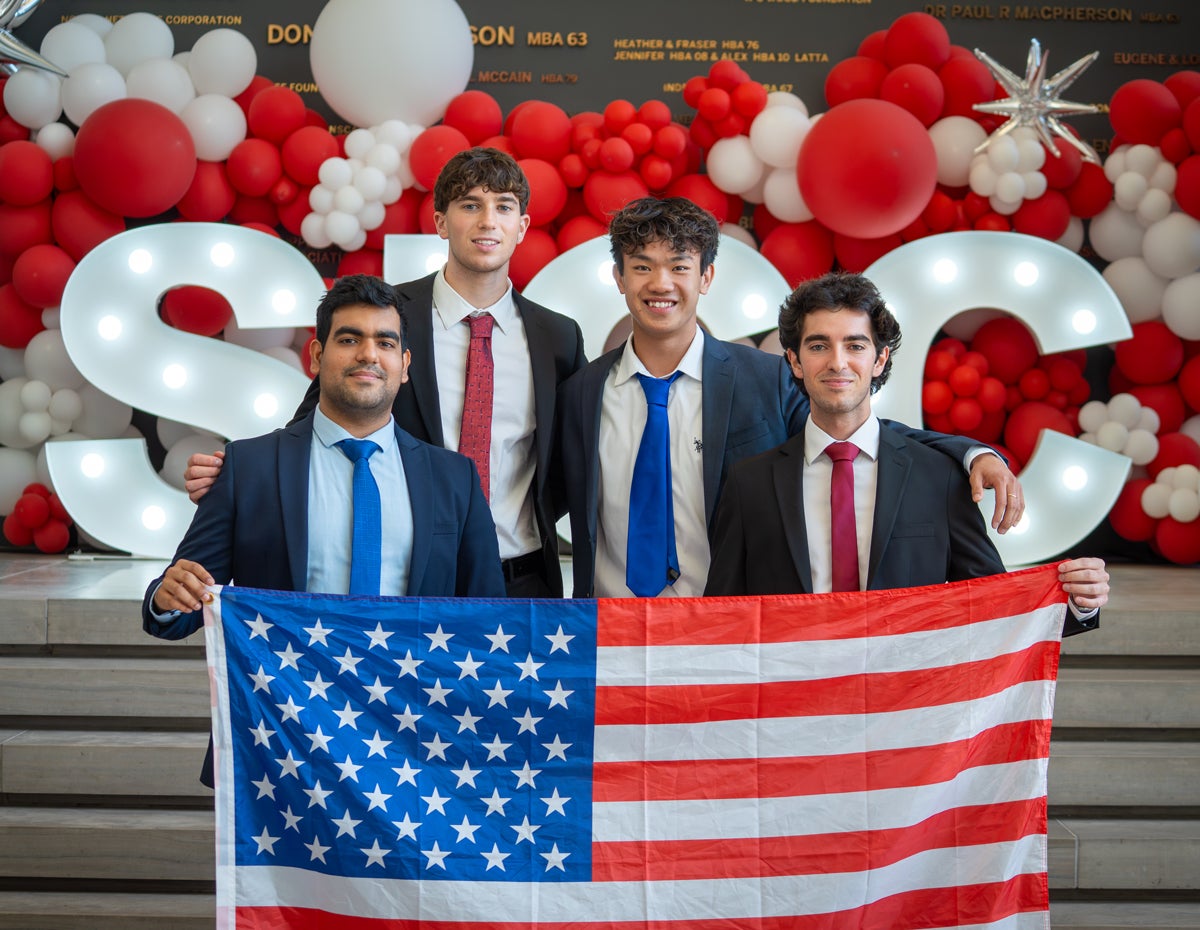
From left, Yash Mirpuri, Omer Chai, Thomas Ngo and Lucas Bonassi put their national pride on display after Florida State’s third-place finish at the Scotiabank International Case Competition in London, Ontario, Canada. Florida State was the competition’s only U.S. team.
A team of four students from Florida State University’s Herbert Wertheim College of Business said they seized a spirit of confidence – thanks to their intense preparation – to earn a third-place finish at the prestigious 36th annual Scotiabank International Case Competition, held March 24-28 in Ontario, Canada.
The only team representing the U.S., FSU students Lucas Bonassi (BS Finance ’26), Omer Chai (BS Finance and Management Information Systems ’29), Yash Mirpuri (BS Finance ’26) and Thomas Ngo (BS Finance ’29) bested most of the 14 international teams from universities spanning five continents and Oceania. The field included competitors from Canada, Mexico, Peru, Nigeria, Germany, Spain, the Netherlands, Thailand, Japan, Hong Kong and New Zealand.
“Hearing Florida State called as a finalist and walking up on that stage in front of all the teams isn’t something you forget,” Bonassi said. “Bringing home third was a really proud moment for all of us.”
The Scotiabank International Case Competition, hosted by the Ivey Business School at Western University in London, Ontario, challenges teams to analyze real-time business problems, present proposed solutions and defend recommendations under tight time constraints. Teams worked through two live case challenges tied to issues considered by many to be global priorities, including decarbonization and improving access to critical services.
In the first case, teams examined the Toronto Transit Commission’s budget to identify $150 million to invest in hybrid or fully electric buses.
The FSU team recommended a line of retrofittable buses that can convert from gas-fueled to battery-powered over time. That paired with operational streamlining, would help the Toronto Transit Commission hit net zero emissions by 2040 while also driving significant new revenue, the team said.
Two days later, teams returned for a second case, this one focused on scaling technology-enabled healthcare delivery Teams evaluated global strategy and expansion considerations of Zipline, a U.S. startup delivering blood and emergency medical supplies to clinics in Rwanda.
The FSU team recommended that Zipline expand into suburban commercial delivery in the U.S. while retaining its existing operations in Africa and honoring its government contracts. The students also outlined a path to an initial public offering within the next five years. In addition, the team proposed that Zipline license its software to healthcare-focused competitors in order to spread the humanitarian value of emergency medical care beyond a single company.
The team's students are members of the Business Case Club at FSU. According to the registered student organization's website, the club "trains students to read and analyze business cases and present solutions to real-world problems," then represent FSU at external competitions.
“We spent a lot of time preparing not just for this competition but building up our skills all year through the Business Case Club,” said Bonassi, who serves as co-president of the organization. “Going up against teams from all over the world was humbling, but our preparation gave us the confidence to compete at that level.”
– Robin Doyle


Address 402 W. Gaines Street, Tallahassee, FL 32301 | Phone 850-644-3090
Copyright © 2026, Florida State University - Herbert Wertheim College of Business, All Rights Reserved. Accredited by AACSB International.